“I’m almost there,” he said aloud.
The Obelisco refused to appear.
The street narrowed. Buildings leaned inward. The air carried less perfume and more iron: hot brake dust, old oil, the sour dampness of overworked drains. Behind him a colectivo exhaled open and shut, its hydraulic breath lingering in the heat like an animal that had considered him and passed.
Ten minutes ago he had known.
A young man outside a kiosk had pointed: straight ahead. Todo derecho. Always forward. Todo derecho. Always forward. In Buenos Aires, direction was architectural. Avenues wide. Façades composed.
In Palermo, jacarandas spilled violet across washed sidewalks. In Puerto Madero, glass towers caught the river light and returned it unchanged.
Here, light snagged on wires.
He checked his phone. No signal. He checked his phone. No signal. He checked again, not believing the first check. It trembled between blocks, unable to commit.
He walked.
A butcher shop sweated beneath a half-lowered grate. Flies traced their patient geometry over meat darkening at the edges. A dog lay in the doorway, ribs sharp beneath thinning fur, one eye open — not sleeping, conserving. A boy kicked a flattened bottle against a wall. The hollow crack echoed, and echoed.
Outside a repair shop, men paused mid-conversation. One wiped grease from his hands. Another spat and watched it merge with runoff.
He felt the shift.
He was certain he felt it.
Once alerted, the mind assembled.
He saw it: the hand on his shoulder, the second man closing in, the arithmetic of surrender. He would return with a story sharpened by injury. You have to be careful there. One street becoming the whole city.
This was not his first cartography of fear.
Three months earlier, in a glass conference room that smelled of lemon cleaner, a man half his age folded his hands. “We’re moving in a different direction.”
Different direction.
He had not known they were allowed to move without him.
He nodded. Smiled. The box they provided: framed photos, a coffee mug, a stapler older than the hands that had fired him. That evening he slid the box into the hall closet and told no one. For two weeks he rose at the same hour, showered, dressed, and sat in his car in a grocery store parking lot, reading postings he never applied to.
Five minutes defining twenty years.
A woman leaned from a second-floor window and shook a rug. Dust fell. She did not look at him.
“Disculpe. El Obelisco?”
She shifted two heavy bags — oranges threatening the plastic, bread already collapsed. She studied him the way one measures weather.
A plaza. A turn. Cuidado.
Careful, she had said, though whether of the street or of him, he could not tell.
He followed where she had pointed, though she was already gone.
The street thinned further. Laundry sagged overhead. A radio played cumbia somewhere unseen, bass trembling in window glass. Someone laughed—sudden, unafraid, belonging.
At the corner, a teenage boy sat on a crate, elbows on knees, watching him approach. A thin silver chain rose and fell at his throat.
“No por ahí,” the boy said, nodding toward a narrower street.
The pavement there was broken into sharp islands. A car without wheels rested on bricks, interior gutted. Windows above were dark, some boarded. No one had moved the car. No one had covered the windows. These were conditions, not events.
“¿El Obelisco?”
The boy shook his head once. “No por ahí.”
“¿Por qué?”
The boy’s jaw tightened. His eyes flicked past the American’s shoulder, then back again, as if reconsidering the answer.
“Porque no.”
Because no.
He stepped closer.
The boy did not move.
The air thickened. Even the bass fell away.
He nodded and continued straight.
He imagined walking down that street. Imagined nothing happening. Imagined everything. Fear, he understood now, was a form of imagination.
Footsteps began again.
Close.
When he slowed, they slowed. He stopped. They stopped.
He turned.
A man in a gray jacket. A thin scar, temple to hairline. A cigarette burning. Direct gaze.
They looked at each other.
He became aware of his wallet, his watch, the cost of his foreignness.
“¿Centro?” the man asked.
“Sí.”
The man lifted his chin left. “Por allá.”
Silence.
He felt an absurd urge to explain—to justify being there, to confess he had only meant to see the monument, not trespass into lives he had only read about.
“Gracias.”
The man flicked ash and stepped past, shoulder nearly brushing his own.
Nothing happened.
The street widened. Traffic thickened. A bus door slammed. A vendor called out choripán. Heat rose in visible waves. Wires thinned against sky.
He passed a storefront with faded Hebrew and Spanish lettering. Books leaned in the window, prayer books, he thought, or history, or both. Their spines bleached pale. An old man stood in the doorway, posture improbably upright.
“El Obelisco?”
“Inglés?”
“Yes.”
“You are close,” the old man said carefully. “But you walked too much around.”
“Two blocks. Left. Then straight.”
“The city is large,” the old man added. “You saw only one.”
He followed the old man’s gesture. Two blocks, then left. The geometry would sharpen soon enough, the avenues widen, the glass return. He knew this now.
A woman passed carrying a basin of wet clothes, the smell of cheap soap and clean cotton. From an open doorway came the sound of a radio— not cumbia now, but something orchestral, swelling and dipping, a violin struggling against static. He did not know the piece. He knew only that someone had chosen it, had turned the dial past the static to find this, had decided this was worth hearing.
A child ran past chasing a hoop made of wire and tape. The hoop clattered on the broken pavement, caught, rolled, fell. The child laughed—not at the fall, but at the recovery, the simple physics of momentum. An old woman on a stoop called out a name he did not catch. The child ignored her, or pretended to, the way children do when they know they are watched with love.
He stopped.
The street had not changed. The laundry still sagged overhead. The car still rested on its bricks. But he saw it now as condition, not warning—the woman shaking her rug not as threat but as Tuesday, the men at the repair shop not as audience but as workers pausing, the boy on the crate not as sentinel but simply a boy warning a stranger away from a street that was his to warn away from, a small jurisdiction, a minor sovereignty.
The fear had been real. The danger, perhaps, had not been.
Or had been only one possibility among many, and he had chosen it the way one chooses a channel, the way the old man had chosen the violin—seeking the frequency that confirmed what he already believed about the world’s interest in his destruction.
He had been fired. He had sat in parking lots. This was true. But he had also, he remembered now, on the third day of his unemployment, watched a man teach his daughter to ride a bicycle in that same parking lot, the girl wobbling, the man running alongside, neither of them aware of him in his car with his box in the backseat, his shame, his unopened applications. He had watched them without deciding what it meant. He had simply watched.
The violin on the radio reached some crescendo and collapsed into noise. The woman with the basin turned a corner. The child caught his hoop and stood, chest heaving, triumphant over nothing, over the simple fact of motion.
He was not almost there. He was here, where the old man had said to turn left, where the city showed a face that asked nothing of him, not even his understanding. He had walked through it afraid, and it had not punished him, and it had not welcomed him, and this—he understood now, or nearly understood. The street belonged to the woman and the child and the old man and the boy on the crate, and for these minutes, it had belonged to him too.
He turned left.
Two blocks.
The geometry sharpened. Buildings rose taller. Glass reappeared. The hum of Avenida 9 de Julio thickened into a mechanical tide.
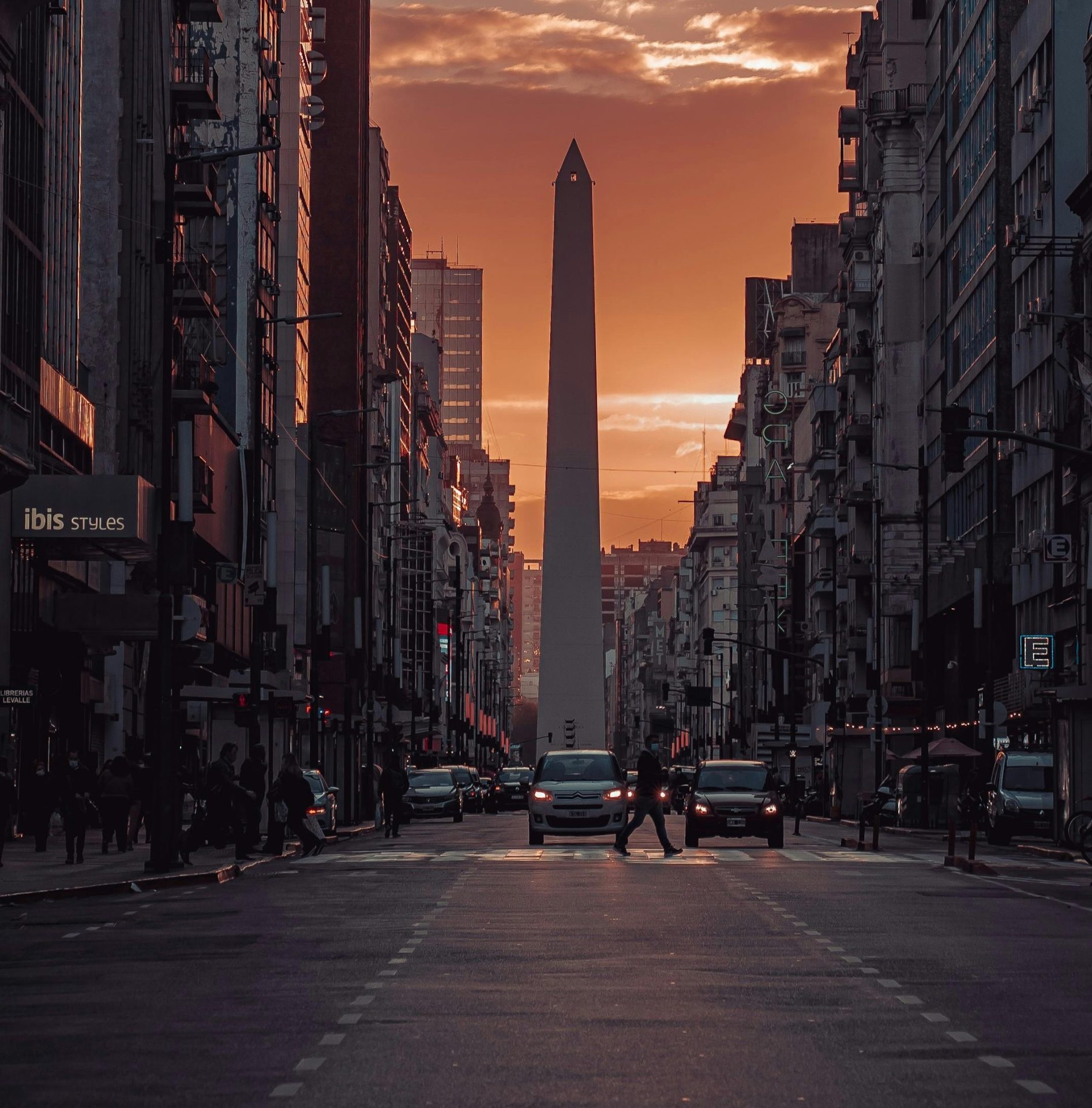
And then, between buildings, the Obelisco.
White. Severe. Chalky. Weather-streaked near its base where rain had traced faint gray veins. Hairline cracks invisible on postcards. At its foot, tourists. Traffic circled without pause.
It did not pierce the sky.
It simply stood there, occupying.
He waited at the curb, as if for permission to approach.
The monument did not care that he had found it. It had stood through collapse, protest, celebration. It would stand through him.
A bus roared past, wind snapping his shirt against his ribs. A couple laughed while framing a photograph. A banner flickered at the far end of the avenue and vanished into traffic.
He would repeat this. In another city. In another room that smelled of lemon cleaner.
Each arrival was only a departure wearing different clothes.
“I’m here,” he thought.
Almost.
The light changed.
He crossed toward the Obelisco.
Above him, the monument rose. He could not tell if it endured or was only heavy.
The city continued without requiring him to understand it. It had only asked him to move through.