At the grocery store
the machine thanks me
for my honesty.
This is new.
Once there were cashiers
with dyed hair, bad knees,
small gossip from the neighborhood,
a look that said
you again.
Now there is a screen
asking whether I brought my own bag
as if this were a moral event,
as if the planet might yet be saved
by me declining twelve cents’ worth of plastic
while corporations pour poison
into rivers with both hands.
Please place item in bagging area.
I do.
I place my apples there,
my bread,
my coffee,
my mild wish to die
before hearing one more corporate voice
try to sound friendly.
Unexpected item in bagging area.
Yes.
That would be me.
All day the country is redesigned
to remove the last accidental contact.
No cashier.
No clerk.
No one to ask
how’s it going,
and lie.
Only instructions now.
Only prompts.
Only a blinking square
waiting for me to confirm
I am not stealing
my yogurt.
The machine has a patience
human beings no longer bother with.
It repeats itself.
It forgives nothing.
It never quite malfunctions enough
to justify murder.
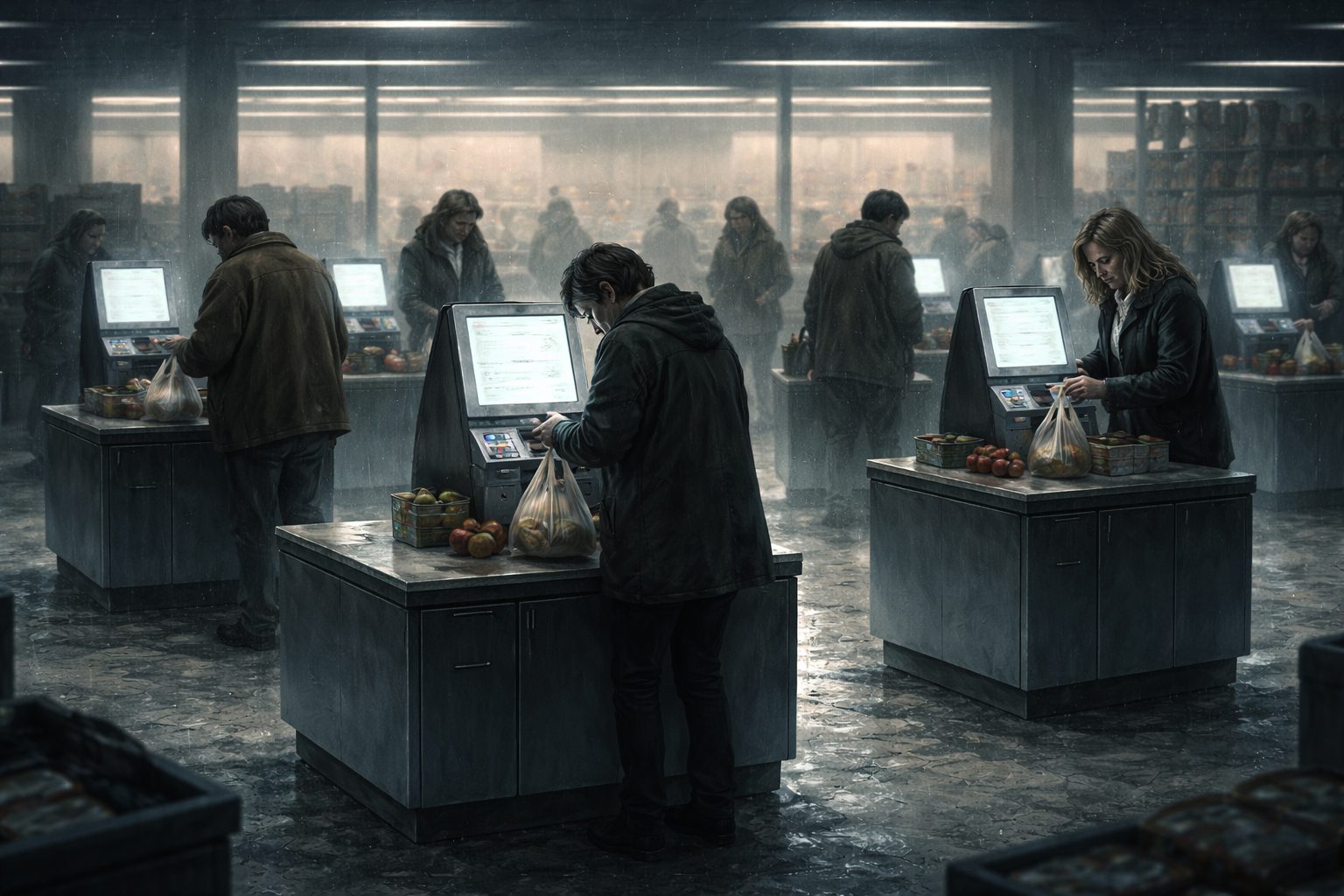
Around me, other shoppers
stand in their little circles of light
scanning bananas,
scanning soap,
scanning whatever remains
of domestic life,
each of us supervised
by one teenager
with the exhausted face
of a minor god.
No one speaks.
We are busy collaborating
with our own replacement.
Then the screen asks
if I want to donate
to hungry children.
This, too, is elegant.
First they erase the jobs,
then they ask the unemployed
to round up for mercy.
I press No
with the clean finger
of a bad citizen.
Outside,
the parking lot shines
with rain and gasoline.
Somebody wrestles bottled water
into the trunk of an SUV
large enough to invade a province.
The doors slide open.
The doors slide shut.
Above everything
that calm synthetic voice
goes on thanking us
for shopping.
As if that were what this was.