A strange thing is happening to creativity: the distance between who we are and what we can produce is collapsing.
Until recently, creative output was constrained by time, skill, stamina, and the slow accumulation of craft. That constraint did more than limit what we could make. It helped define who we were. A voice was yours because it was hard-won. A style was yours because it took years to develop.
Now a set of artificial intelligence (AI) tools can imitate patterns, amplify strengths, and often improve work faster than we can. This capacity shows up in writing and speech, in musical ideas and visual design choices, and in the ability to reproduce a creator’s voice and style on demand. Put bluntly, AI can do you better than you can do you, at least in certain tasks, and at least some of the time.
That can sound like an insult. But it is also a reality worth facing, because it changes the central question from how we create to something more unsettling: what it means to be the creator when your voice and style can be generated on demand.
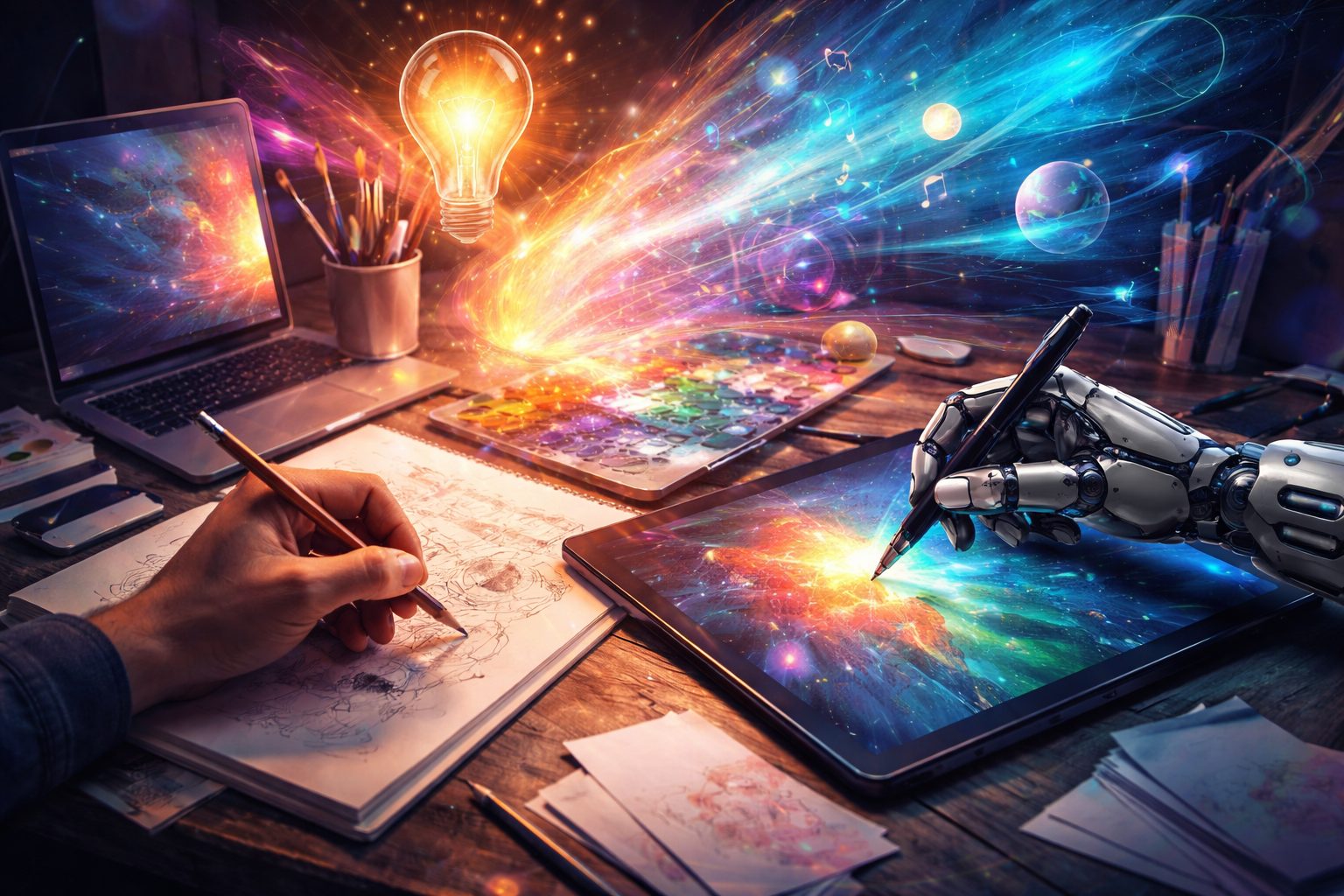
It is tempting to treat today’s AI as a convenience, like spellcheck with swagger. But the shift is bigger. These systems do not merely correct errors. They propose choices. They do not merely execute. They co-author.
In writing, a rough paragraph can become a cleaner one in seconds. You can ask for alternate openings, endings, and tones. You can ask for a tighter argument, a clearer structure, or the counterargument you did not anticipate. The friction that used to force clarity through time turns into a menu of options.
In music, you can sketch a mood and get a full arrangement. You can turn lyrics into a sung demo. You can iterate on structure and energy quickly, as if composition were an editing task. And voice technology makes the sound of a person increasingly editable, not only polished but re-created.
In visual art and video, you can generate images and short sequences from descriptions, then revise them the way you revise prose. Remove this. Add that. Make it warmer. Make it more human. The skill shifts away from raw execution and toward directing, selecting, and refining.
This is why the moment feels destabilizing. It is not just that AI can produce generic content. It is that it can produce content that resembles your content, at scale. It can learn your habits, your rhythms, your favorite moves, and then repeat them. What used to be a signature earned through repetition can now be simulated through pattern.
For a long time, we have relied on intuitive categories to judge creative work and assign credit: original versus derivative, authentic versus fake, human versus machine. AI blurs all three. If you use AI to tighten your prose, is it still your voice? If you ask for ten versions and pick the best one, did you write it? If a system draws from a vast cultural archive, where does influence end and appropriation begin?
There is no single clean answer, and pretending there is one keeps us stuck in the wrong debate. A better frame is that we are entering an era of co-produced work, shaped by human intention and machine suggestion.
Refusal is a valid personal stance, like refusing social media. But it will not be a viable collective stance. The incentives are too strong, and AI is increasingly woven into everyday creative software. Avoiding it will take effort, and over time that effort will feel less like a principled choice than a self-imposed handicap.
So the realistic question becomes how to use it without losing ourselves.
The least melodramatic answer is also the most practical. Use AI as a collaborator, consciously and skeptically, with your hands on the wheel.
Think of it as a force multiplier, not a replacement. Think of it not as a ghostwriter, but as an inexhaustible partner that can brainstorm when you are stuck, draft quickly so you can edit harder, stress-test your argument, and handle tedious steps so you can focus on meaning.
Used in this way, the technology does not decide what the work means; you do. The real question is not whether you used AI, but whether you owned the decisions. Did you make the core choices? Do you endorse the tone and implications? Could you explain why the major decisions are there? Are you using AI to avoid the hard parts that make you better, or to accelerate the parts you have earned?
Creators will draw different boundaries. Some will use AI only for brainstorming. Others will use it for drafting but rewrite everything. Some will use it for production but avoid synthetic voice. What matters is not purity. It is responsibility.
On a societal level, we need norms and disclosures that protect trust without collapsing into hysteria. People deserve to know when a voice is synthetic, when an image is generated, when a piece was materially shaped by automation. At the same time, we should admit the obvious: the boundary will blur because collaboration blurs boundaries.
AI can out-execute us in narrow ways. It can draft faster, propose more variations, and sometimes land on a line you wish you had written. But it cannot decide what deserves to exist. It cannot take responsibility for meaning.
That part remains human, if we insist on keeping it.