I had gone to the Museo Nacional de Bellas Artes with no plan beyond the plan every visitor half-makes and mostly abandons – to look at what was free, to stay indoors through the worst of the afternoon chill, to see something that might later justify having spent a day in a city built for walking by sitting still instead. I fell in with a public tour more or less by accident, drawn less by the paintings than by the guide’s voice, a voice that had made a private decision, long before I arrived in the room, that boredom was a choice rather than a fact, and that she personally did not intend to make it.
Marina knew, before she began, which of them would leave early.
It was not a gift, exactly. It was one of the minor professional skills no museum listed in a job description: the ability to identify, within thirty seconds of entering a gallery, the person whose attention had been lent under protest. The husband in the linen shirt already checking his watch. The adolescent boy who had been told there would be lunch afterward. The woman in sneakers carrying a phone at chest height, recording the room in brief, furtive sweeps as if proof of having entered it might later substitute for having looked.
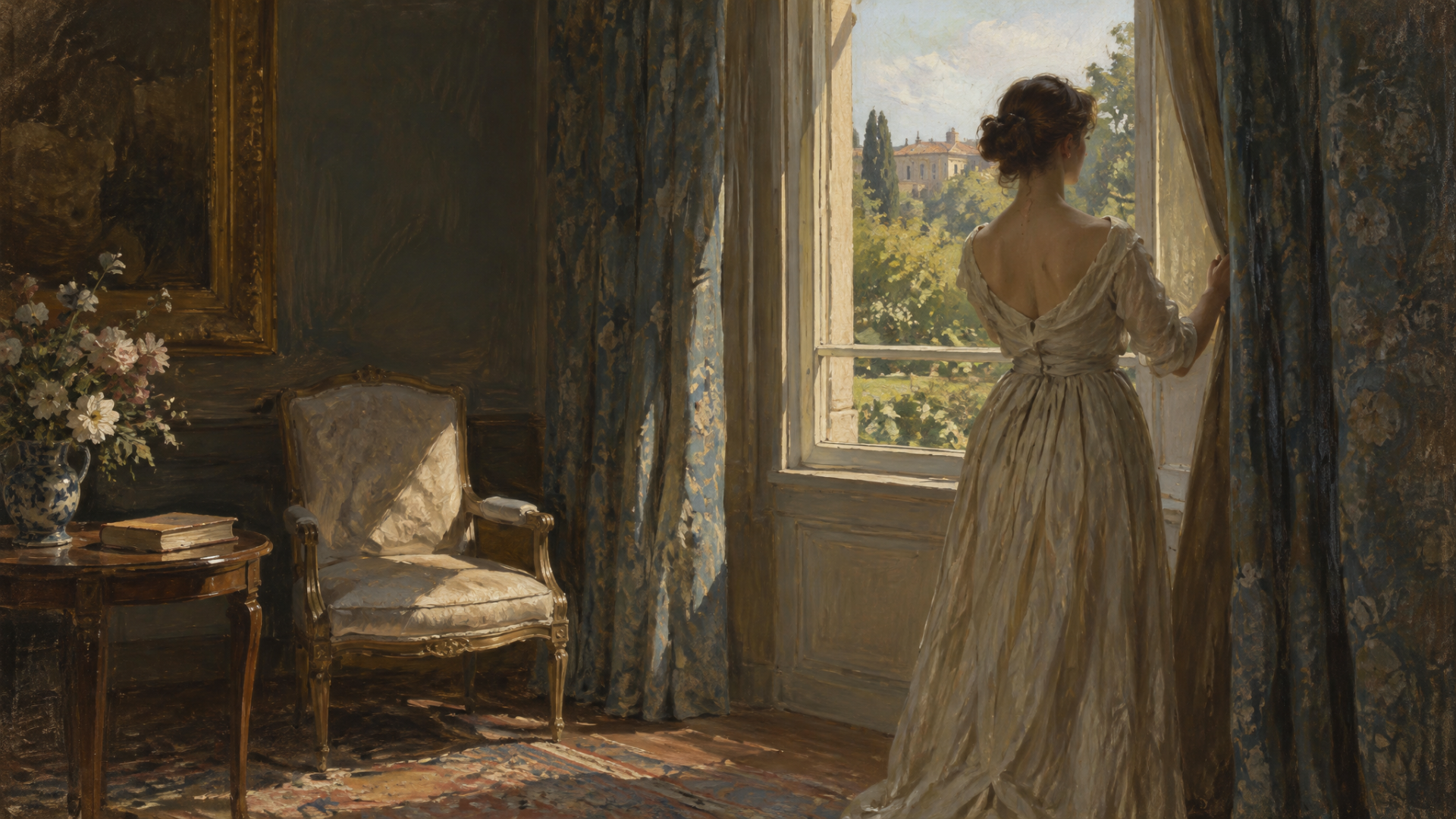
There were twelve of them in the European painting gallery that afternoon, gathered in a loose crescent before a large nineteenth-century canvas of a woman at a window. Outside, a garden. Inside, a room arranged so beautifully that nobody in it appeared to have used anything: the pale chair untouched, the small table holding a book that had never been opened, the curtains gathered as though by someone who had stepped out of the frame one moment before the painter arrived.
Marina waited until the room settled around her.
“People often think this is a painting about waiting,” she said.
The woman with the phone lowered it a fraction.
“It is not. Or not only. It is a painting about being seen waiting. That is a different occupation altogether.”
The visitors looked again. They always did, after that. It was one of Marina’s reliable entrances: not a fact, exactly, but a permission. The woman at the window had one hand resting on the curtain. Her face was turned toward the light, though not far enough for anyone to see precisely what she saw.
“Notice,” Marina continued, “that the room is more finished than she is. The furniture knows its role. The flowers know their role. Even the light has been arranged. But she has not decided whether she belongs to the room or whether she is about to leave it.”
The boy, to Marina’s mild surprise, looked up.
“Maybe she owns it,” he said.
“Maybe,” Marina said. “And maybe that is the problem.”
There was a small laugh from the group, the kind she liked best: not laughter at a joke but the sound people made when a door opened somewhere they had not expected. She smiled at the boy.
“Ownership is never as simple as it looks in a painting.”
At the back of the group, the man in linen checked his watch again. Marina saw it in the reflected glass of a nearby frame. She did not resent him. Resentment was expensive, and she had learned to spend it only where it might do some work.
She wore the blue jacket because the gallery light was flattering to it. It was the same blue jacket she had worn two Thursdays earlier, and the Thursday before that, though no one on a public tour would know it. The fabric still held its shape if she hung it properly at night. The sleeves had begun to shine faintly at the elbows, a private betrayal visible only when she turned her arm toward the window. That morning she had used the last of a bottle of spray meant to refresh wool between dry cleanings. The bottle had cost more than it should have. Everything cost more than it should now, except labor, apparently.
A woman near the front raised her hand.
“Is she sad?”
Marina looked at the painting.
“I don’t know,” she said. “But she has had the good sense not to tell us.”
That drew a fuller laugh. Even the man in linen looked up.
The museum had been open for more than an hour before the tour began, and its rooms had already filled with the usual mixture of school groups, foreign visitors, retirees, couples who were fighting softly in three languages, and people who came alone and stood very still in front of paintings whose names they did not know. The Museo Nacional de Bellas Artes was free. Marina was proud of that. It had always been free, and in recent years its free admission had acquired the moral brightness of an old promise held against bad weather.
She believed in the promise.
She believed in the woman from Flores who brought both her daughters on Sunday afternoons and never rushed them. She believed in the teenage boys who entered laughing too loudly and then quieted, almost despite themselves, in front of a Goya. She believed in the retired accountant who came every Wednesday to sit before the same portrait and leave exactly forty minutes later, as if clocking in at a job no one else knew he had.
What she did not believe in, not anymore, was the institutional sentence that always appeared in public statements: The museum continues its commitment to excellence.
The museum continued. That was true.
Excellence was another matter.
“Now,” Marina said, drawing the group toward the next room, “let’s look at what happens when a painting refuses to behave.”
The boy followed her. So did the woman with the phone. The man in linen came last, though he came.
I stayed until the end, past the point where staying could be explained by curiosity alone, and when the group dissolved into its usual scatter of thanks and photographs, I found myself the last one standing near her, with nothing better to offer than the truth – that I had liked the way she talked about the woman in the painting more than I had liked the painting itself. She looked at me the way people look at a compliment they’ve decided, provisionally, to accept.
“You’re not from here,” she said.
I admitted I wasn’t, and asked whether she had time for a coffee before the museum closed around her entirely. She considered this longer than the question deserved, weighing what version of herself it would cost to answer.
“One condition,” she said. “If I tell you anything true, you don’t get to make it charming.”
I told her I would try. We sat in La Ferneteria the better part of an hour, and she gave me pieces—the cuts, a meeting the next morning she was dreading, a rent that had risen twice in a year, a mother in Caballito who believed she still lived somewhere she no longer lived. Not all of it, and not in order. What follows is the rest of that day, which I did not witness, I have tried to imagine toward her, not around her, reconstructed with more fidelity to her than to my own certainty.
By five o’clock, after the final questions and the final grateful, distracted applause, Marina had walked nearly six kilometers inside the museum.
She knew this because she had begun counting steps during the second month after the cut, when she stopped buying the small coffee from the kiosk across the avenue and started walking the galleries at lunch instead. Her phone tracked distance, sleep, movement, weather, the speed at which she climbed stairs. It could not tell her how much a person lost when a salary stayed the same but could no longer buy the life built around it.
She returned to the education office by way of the long corridor behind the temporary exhibition halls.
The first door on the left was still labeled PROGRAMAS PÚBLICOS. No one had changed the sign. The office behind it had been empty since February.
At first they had used it for boxes: old brochures, folded easels, a cracked monitor no one had authorization to dispose of. Then someone had carried in three plastic chairs from the auditorium, and the room became a kind of waiting area for objects that had outlived their assigned purpose.
Marina did not look inside as she passed. She had trained herself not to.
She told me about that room.
In the education office, Inés was sitting at the shared desk with her shoes off beneath the chair, studying a spreadsheet with the expression of someone reading a medical test result.
“Did they stay until the end?” she asked.
“Most of them.”
“Then you are a miracle worker.”
“I am a woman in a blue jacket.”
“Same thing.”
Inés was younger than Marina by fourteen years and had begun at the museum as an intern when Marina was already leading tours for visiting academics and donors. She had a quick, clever face and an excellent memory for names. Before the cuts, before the retirements that had not been replaced and the resignations that had been accepted with polite bureaucratic sorrow, Inés had talked about applying for the postgraduate program in curatorial studies. Now she worked four days a week at the museum and three evenings at a private language institute in Belgrano.
“You have the meeting tomorrow,” Inés said.
Marina put down her folder. “I know.”
“They sent another email.”
“Of course they did.”
“They want us to bring proposals for ‘efficiency in visitor engagement.’”
Marina laughed once. It surprised her how little sound it made.
“Perhaps we could engage visitors more efficiently by allowing them to staff the building.”
Inés did not laugh. She looked at the spreadsheet.
“My rent went up again.”
There was no theatricality in the statement. It was merely a fact. A notification had arrived, a number had changed, an apartment had become more expensive to remain in.
Marina opened her bag and took out her phone.
“By how much?”
Inés told her.
Marina made the face one made in response to other people’s numbers. Sympathetic. Properly appalled. Not too intimate. She did not say that hers had risen by nearly the same amount, or that she had spent Sunday afternoon at the kitchen table of her new apartment with a notebook, dividing the month into categories that became less dignified the longer she looked at them.
Rent.
Electricity.
Transport.
Medicines for her mother.
Wardrobe.
She had written wardrobe reluctantly, then crossed it out, then written work clothes, which was truer and somehow worse.
“You should speak to the landlord,” Inés said.
“I’m sure he will be moved by the cultural value of my employment.”
“Tell him you lead tours.”
“He’ll raise it further.”
This time Inés smiled.
At six, Marina went downstairs to the staff bathroom and changed her shoes.
The black pumps had a small tear near the right sole, not visible from above. She had placed a strip of black tape beneath it that morning, pressed carefully into the leather while standing at the kitchen counter. At the museum, the sound of the shoes on stone made people turn toward her with the automatic respect given to someone who seemed to know where she was going.
In the bathroom, with one foot balanced on the closed lid of a toilet, she peeled off the tape and folded it into a square before putting it in her pocket.
The shoes were not ruined. Not yet.
Her mother had taught her that nothing was ruined until you had tried three things.
She thought of her mother then, sitting in the apartment in Caballito where she had lived for thirty-nine years, refusing to sell despite the elevator’s frequent betrayals and the damp spreading along the hallway ceiling. Her mother still believed Marina lived in Recoleta. Not exactly believed. They had not discussed it.
When Marina moved, she had said only that the new place was “more practical.”
“Practical for what?” her mother had asked.
“For saving.”
Her mother had looked at her too long.
“You always hated saving,” she said.
“I’m older now.”
“That is not the same as wiser.”
Marina had brought her mother a bag of oranges and changed the subject.
In the locker room, she took off the blue jacket and hung it carefully over the back of a chair. Under it she wore a black blouse with one missing button at the cuff. She had moved the button from the inside hem, where no one would see the absence. The blouse had been a gift from a friend, Julia, during a period when friends still gave each other clothes because they had seen something and thought, immediately, of the other person’s life.
Julia had given it to her in the old apartment on Junín, after dinner one summer night when the windows were open and the city smelled of rain on pavement and hot dust.
“You need this,” Julia had said, holding it up.
“I need many things.”
“Start with this.”
They had been six around Marina’s table then: Julia and her wife, Andrés from the museum with his new girlfriend, Lucía from university, and Marina, who had made a salad too elaborate for the heat and opened the wine before anyone arrived. The apartment was not large, but it had high ceilings and tall doors and a balcony narrow enough for two chairs. The living room filled with people easily. That had been its talent.
At some point, Andrés had stood in the doorway to the kitchen with his glass raised and said, “You should charge admission. You make everyone look better in here.”
Marina had laughed and told him that was the definition of good lighting.
She had believed the apartment was an extension of herself: not proof of wealth, certainly, but proof of arrival. She had worked for years to live near the museum, close enough to walk beneath the plane trees, stop at the bakery on Vicente López for warm bread, and hear friends say, casually, “We’ll come by yours afterward.”
The last dinner she held there was smaller.
Only Julia came.
They ate pasta from mismatched bowls because Marina had already packed the plates. The books were in boxes. The framed print above the sofa had been taken down, leaving a pale rectangle on the wall. Julia drank wine slowly and did not ask whether Marina was sure.
“I’m not leaving the city,” Marina said finally.
“No.”
“It’s forty minutes on the train.”
“No.”
“It has better light in the morning.”
Julia looked around at the boxes.
“You don’t have to make it charming for me.”
Marina had wanted to say: I have to make it charming for someone.
Instead she said, “I’m trying not to make it tragic.”
Julia reached across the table and touched her hand.
“That’s different.”
At the station, the train was already crowded.
Marina took her usual place near the door, where she could lean without appearing to lean. The blue jacket was folded over her arm. She had changed back into low black shoes, softer and older, their leather creased across the toes. She did not wear them to the museum; those floors required the heels, however taped, that demanded to be heard.
The doors closed.
For three stops, the train moved through a Buenos Aires she could still claim without qualification. The façades remained high and composed. Balconies held plants that had survived generations of women watering them from above. Cafés gathered light behind glass. People in coats walked dogs with the calm authority of people who expected the sidewalks to belong to them.
Marina watched the city slide past in the window and, as often happened, saw her reflection layered over it: her hair still pinned neatly, lipstick fading at the center, the fine line at the corner of her mouth she had begun to notice in photographs.
She looked like a woman returning from work at a museum.
She looked, she thought, like someone whose rent had been paid.
At the next stop, more people boarded. A man with a large bag pressed against her shoulder. A child in a school uniform slept sitting up between his mother and an older woman who might have been his grandmother. Two teenage girls shared earbuds and laughed silently at something on a phone.
Marina’s own phone vibrated.
Banking App: Debit scheduled tomorrow. Insufficient balance likely.
She read it once. Then again.
The rent would clear if she transferred money from the account she had once called travel, though she had not traveled anywhere in eighteen months except to visit her mother. The electricity bill would wait until Friday. The card payment could become next month’s problem, which was how problems developed families.
She placed the phone back in her bag.
Outside, the buildings grew lower. The polished storefronts gave way to hardware shops, pharmacies with faded signs, mechanics’ garages open to the street. Laundry appeared on balconies in quantities that suggested not domestic charm but the weekly arithmetic of bodies. A factory wall had been painted with an advertisement for a mobile company whose colors had bleached until only the face of a smiling woman remained.
Marina had passed this wall hundreds of times. She could not remember when she had begun to think of it as a landmark.
The train slowed.
In the window, the museum disappeared from her reflection. Or perhaps it was only that the interior lights came on.
She got off at the third stop after the line crossed into the neighborhood where she now lived. The station was clean enough, in the way stations were clean when a single person had done what could be done with a broom and a bucket before dawn. The stairs smelled faintly of wet concrete. On the street, a man closed the shutters of a ferretería. A woman in a green uniform pushed a cart past the bus stop, speaking into her phone with the tired, affectionate irritation of someone who had been repeating the same instruction to a child all day.
Marina walked three blocks.
The apartment building had been painted yellow once. Now it was a color between yellow and dust. The entrance light flickered as she stepped inside. On the second floor, someone had left a pair of sneakers outside a door. On the third, the neighbor’s television was loud enough that she could hear the applause track through the wall.
Her apartment was on the fourth floor, facing the back.
The elevator had been working all week, which made her suspicious.
Inside, she did not turn on the main light. The lamp in the living room was enough. It had belonged to her grandmother, a narrow brass thing with a shade Julia had once described as “aggressively elegant.” In the old apartment, it had stood beside the sofa and made the room look warmer than it was. Here it sat on a plastic side table from a supermarket, its circle of light falling over half-unpacked books and a chair with a blanket folded on the seat.
Marina placed the blue jacket over the chair.
Then she stood in the room without taking off her shoes.
The apartment was not terrible. This was important to her. It had a working stove, if you turned the left knob twice. It had a window that faced a courtyard where an elderly man grew basil in cans. It had one bedroom, a small kitchen, a bathroom with a shower that took several minutes to decide on a temperature.
It was more than some people had.
She hated herself a little whenever she thought that, because it made gratitude into another instruction.
On the refrigerator, beneath a magnet from the museum shop, she had placed a postcard of the woman at the window.
The image was smaller than her hand. The room in the painting had become almost absurdly beautiful at that scale: the curtains, the flowers, the polished floor, the woman’s composed uncertainty.
Marina opened the refrigerator and found half a container of lentils, a lemon, and a bottle of water.
She ate the lentils cold at the kitchen counter.
Her phone vibrated again. This time it was Julia.
Dinner Friday? At ours. No excuses.
Marina looked at the message for a long time.
She could say yes. Julia would not make her pay for anything. Julia would send a car if she needed one. Julia would not ask why Marina had declined the last three invitations or why she always suggested meeting near the museum, in the part of the city that allowed her to leave first.
Marina typed:
I have an evening event at work.
She stared at it.
Then deleted it.
She typed:
Yes. I’d like that.
Before she could reconsider, she sent it.
In the quiet after, she washed the lentil container and placed it upside down on a towel. She checked the blue jacket for the small stain near the cuff, found none, and hung it carefully in the closet. Beside it hung two dresses, one black skirt, three blouses, and the grey coat whose lining had torn under the arm.
She did not count them.
In the living room, the postcard waited on the refrigerator door.
Marina stood before it, still in her work clothes, and looked at the woman at the window. Tomorrow she would tell another group that the woman had not decided whether she belonged to the room or was about to leave it.
The woman had already left.
The room had simply not noticed yet.