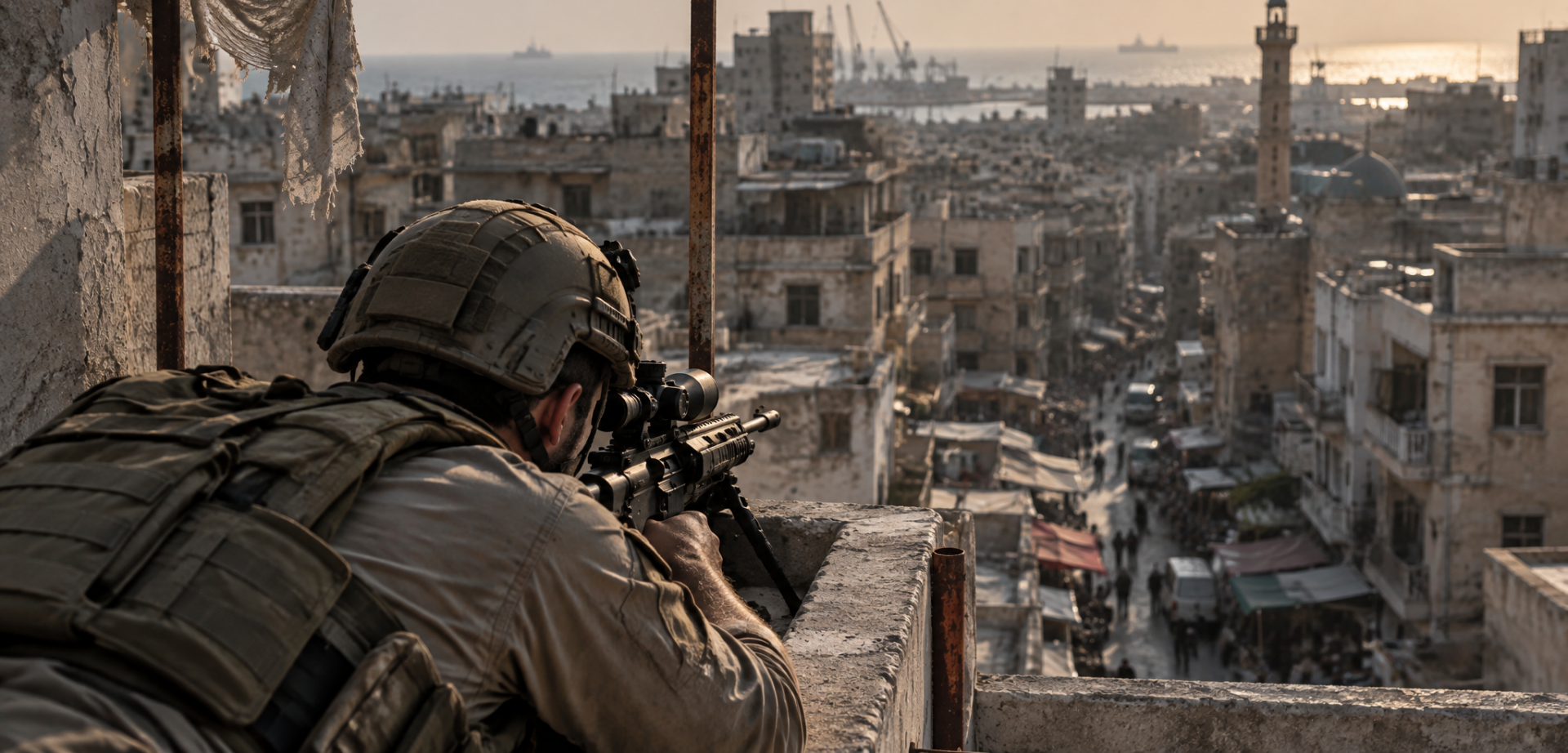
The rooftop was somebody’s home before the war made it a position.
Concrete. A low wall. A laundry line gone to rust in the salt air.
Through the scope: streets, doorways, a market that used to open at six. Not people. Categories. Amal here. Phalange there. Druze, Shiite, whichever militia held whichever block that week. The infantry moved through the alleys below us and we watched their backs, and behind the reticle a shape was either a threat or it wasn’t, and there was no room in that arithmetic for the third possibility, which was simply a man going to buy bread.
I did two tours like this. Multinational Peacekeeping Force. American, British, French, Italian. We called ourselves peacekeepers, and we meant it, and behind that word stood a reinforced infantry battalion, artillery, naval guns offshore, air support on call.
A very big stick, for a very small country.
Nobody who has ever stood beside that much firepower and still called it peacekeeping gets to pretend hardware is the whole argument. It isn’t. What made us peacekeepers instead of occupiers was never the guns. It was something upstream of the guns—a posture, a discipline, an agreement about what the weight in your hands was for, and who it was and wasn’t pointed at.
The wardrobe follows the posture. It does not create it.
But it does announce it. And once announced, it teaches everyone who wears it after you.
Individual civilians were mostly unknown to us. We were well acquainted with the factions instead—their colors, their checkpoints, the way each one moved through a street it considered its own. That is what overwatch trains an eye to do. It sorts a population into threat and non-threat, faction and civilian, until civilian becomes a kind of afterthought, the residue left over once the real categories are accounted for. Total detachment from your surroundings. Necessary detachment, in a civil war.
That eye comes home with you. It should have stayed in Beirut.
Watch an American patrol car pull to a curb, thirty years later, four thousand miles from any rooftop, and ask what eye is doing the looking. The answer is not a theory. It’s a uniform. It’s always been a uniform—the first thing any armed body tells you about itself is what it chose to look like.
Police blue was never an accident, and it was never neutral. When London stood up the Metropolitan Police in 1829, the uniform was chosen specifically to distinguish officers from soldiers, who wore red. New York followed the same logic when it adopted blue for its own force in the 1850s. The color was invented to say, before an officer said a single word: not a soldier. For more than a century, “the boys in blue” was the whole American vocabulary for policing, and the phrase did real work. It told a citizen what he was looking at before he had to ask.
Somewhere in the last four decades, in jurisdiction after jurisdiction, blue started going dark. Call it tactical. Call it modern. Departments that once dressed a beat cop the way you’d dress a mailman began dressing him the way you’d dress a soldier standing a checkpoint. Black BDUs. Load-bearing vests. Cargo pockets built for magazines instead of ticket books.
Nobody wrote a memo announcing the change in meaning. Nobody had to. A color that was chosen in 1829 to say not the military does not become the color of the military by accident.
The hardware moved with the color. A sidearm and a nightstick were the tools of a beat cop’s trade for most of a century.
Ferguson, Missouri, August 2014. A residential street, the kind with front porches and a corner gas station. An armored truck holds the intersection. On top of it, an officer in camouflage lies prone behind a rifle, sighting down a suburban street the way I once sighted down a street in Beirut—same posture, same angle of the elbows, same stillness in the shoulders. Behind him, more men in the same camouflage, carrying the same rifles, facing a crowd of their own neighbors.
I recognized that rooftop. I have never stood on it, and I recognized it anyway.
None of that hardware walked into Ferguson on its own. A federal program built during a different war, never quite retired, has spent thirty years moving surplus rifles and armored trucks out of military depots and into small-town evidence rooms, one paperwork request at a time. Nobody smuggled it in. It arrived through the front door, requisitioned in daylight.
And the boots. Not incidental, the boots. A man in oxford shoes carries himself one way down a sidewalk. A man in combat boots carries himself another. The body knows what it’s dressed for before the mind catches up, and it walks accordingly.
Community policing used to mean a name on a first-name basis, a beat walked slowly enough to be recognized, a badge that belonged to the block as much as to the department. What replaced it, in too many places, is presence—patrol as a demonstration of force rather than a relationship with a neighborhood, occupation’s grammar borrowed wholesale and repurposed for Tuesday afternoon traffic stops. The argument for presence is not stupid. A visible rifle does deter. The question is what it deters, and what it creates while it’s deterring.
No chief signs a purchase order that reads: make us look like an occupying force. I doubt any of them intend that, and I have no rooftop from which to prove otherwise.
But a woman on her porch, watching that truck idle at the end of her block, does not convene a committee on departmental intent before she decides whether to sit still or go inside. She reads the wardrobe. That is the only vote she gets, and she has been casting it the same way for thirty years, in meeting after meeting, city after city, telling anyone who would hold a microphone to her what that truck looks like from her porch.
What looks intentional is not the militarization. It’s the dismissal of her reading of it. Ignoring a fear that specific, voiced that consistently, for that long, stops being an oversight. At some point it becomes a decision.
Flags tell you what a thing believes about itself.
The American flag is red, white, and blue—union and rebellion pressed into the same cloth, thirteen stripes for thirteen colonies that once needed defending from precisely this kind of authority, arriving in precisely this kind of uniform.
The flag flown behind so many patrol cars now, stitched onto so many sleeves, is black and white, cut through with a single blue line.
Ask what got left out.
Red is gone. The rebellion is gone. What survived the edit is the line itself—one color, standing alone, holding a division rather than a union. A flag with the red bled out of it is not a smaller version of the first flag. It is a different claim entirely, and the claim is division: an us, drawn in blue, and everyone else, left in black and white, whichever side of the line they happen to be standing on tonight.
I know what the flag means to the people who fly it. I have watched a widow pin it to a casket. Grief is allowed its symbols, and I would not take this one from her. But a symbol does not stop meaning what it’s built from just because it’s carried in sorrow—and what this one is built from is an edit. Someone, at some point, took a flag whose whole argument was red-and-blue disagreement, and deleted the red. The people flying it mostly didn’t make that edit. They inherited it. But inheritance is how meaning travels, and the meaning that traveled is the stripe alone—holding a division, not a union.
I have heard officers, more than once, describe a scene as containing “officers and civilians”—as though the two were different species of person, as though the badge transferred a man out of the category altogether.
It didn’t. A police officer is, by every legal definition that matters, a civilian. Not military. Not exempt from the constitution the rest of us live under. The word has a technical life—in use-of-force reports and municipal codes, “civilian employee” just means “not sworn,“ and nobody should fault a clerk for using it precisely. But in the sentence I keep hearing—a scene containing “officers and civilians”—the word is doing something the technical sense doesn’t require. It is drawing a line the law never drew, between a citizen and everyone else. A free society ought to hear that line, wherever it’s drawn in that particular tone, as a small alarm.
No peacekeeper I served beside would have made that mistake. We knew exactly what we were and exactly what we weren’t, and the distance between soldier and citizen was the entire reason we existed—to protect that distance, not to blur it. A Marine on a rooftop in a civil war has an excuse for seeing a population in categories. An American patrol officer mostly does not—and I say mostly, because two officers were shot through the windshield of their car in Brooklyn while I was writing this, and a society that asks a man to knock on strange doors for a living owes him more than my certainty. What it does not owe him is the eye. A vest is equipment. A rifle, in the trunk, is equipment. The eye is a decision, and it can be stood down.
A free society does not police itself from a rooftop, and it should not be staffed, however unintentionally, by people trained to think like they’re on one.
Overwatch has its place. Beirut needed it badly enough that four nations sent their sons to provide it. Main Street does not, and the country that keeps dressing its street cops for a rooftop they were never meant to occupy should not be surprised when the people underneath start looking up and asking who, exactly, is being watched.
Somewhere on that street, right now, a man is walking to buy bread.
He is not a faction. He is not a threat profile, not a species of civilian, not a shape a trained eye has to sort before it can rest. He is just a man, and a free country doesn’t get to build an eye that has to be told that.
The rifle was never the whole danger.
The eye behind it was.