The automatic doors don’t open so much as capitulate, sliding back like they, too, would rather not, and I step through into the fluorescent nave of the place I have always hated with something close to devotion—the ceilings too high, the carts always missing a wheel, the whole building humming at a frequency pitched to make you buy things you didn’t know you needed until you stood in the aisle that sold them.
I need four items. Paper towels, the good coffee, a birthday card for a nephew who won’t read it, and Gorilla Glue, because something in my house has come apart again, the way things do.
I ask an employee—a young man restocking cereal with the particular resentment of someone paid by the hour to care about things he doesn’t—where I might find adhesives, and he tells me, with the flat confidence of scripture, aisle 457-B.
There is no 457-B. There is no building on this earth with four hundred and fifty-seven aisles. I walk the store like a man doing penance, past the seasonal furniture nobody asked for, past a wall of protein powder promising a self I will never become, and I find the glue, finally, in aisle 12, filed under Automotive for reasons no committee will ever explain to me.
I check out. I walk to the car. And somewhere between the cart corral and the driver’s seat, I understand, with the specific cold drop of a man discovering a wound after the pain’s already started, that my phone is gone.
Not gone. Left. In the basket. In the cart. Currently, at this moment, the property of whichever stranger wheeled it away toward the produce or the parking lot or the ends of the earth.
I don’t panic. I open the iPad in the glovebox—the one I keep for exactly this kind of quiet catastrophe—and there it is, my own small blue dot, still inside the store, still moving, oblivious, carried by someone who does not know they are now, however briefly, the custodian of my whole exterior life.
The reasonable thing is to go back in. I do not do the reasonable thing.
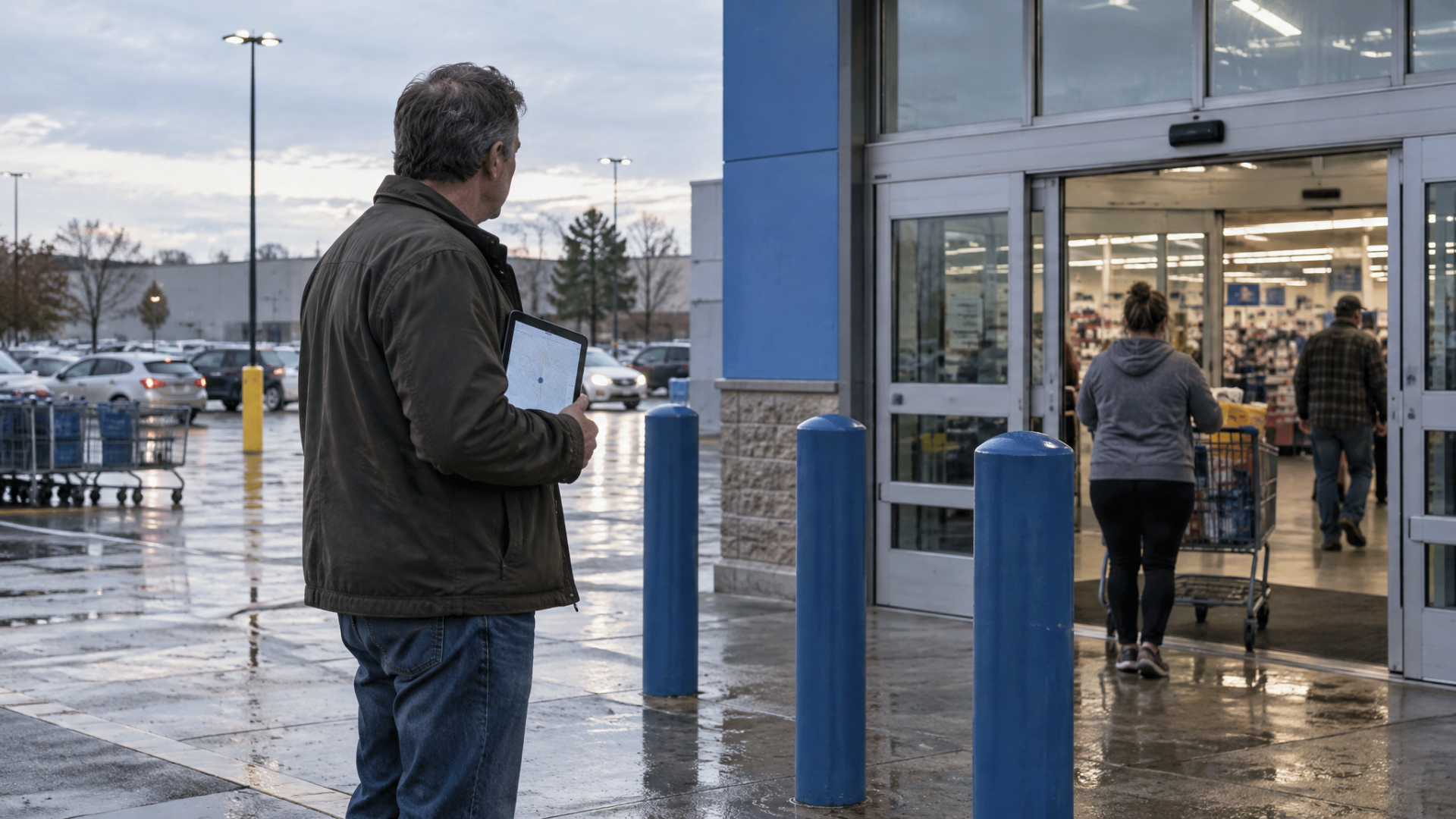
I have decided—and I want it on the record that I decided this calmly, the way a general decides a siege—that it is far more efficient to simply stand by the exit and let the phone come to me. Let the geometry work in my favor for once. I plant myself by the sliding doors with the iPad held low against my chest like a man dowsing for water, and I wait.
And because waiting is its own kind of confession booth, I start doing the math a man does when he has nothing left to do but hope. If it’s a man who grabbed that cart, I tell myself, this will be quick—men move through a store like they’re evading capture, in and out, no browsing, no second-guessing the cereal. If it’s a teenager, better still—some kid will silence the buzzing thing in his pocket without a glance, toss it back the second it rings, wanting no part of a stranger’s phone or a stranger’s problem. But if it’s a woman, I think, and I hear the ugliness of the thought even as I have it, she’ll be all day. She’ll finish her list first. She always does.
This is where I learn things about myself I didn’t ask to learn.
Because a man standing outside a Walmart holding a tablet is, apparently, a salesman. I am mistaken for one within ninety seconds. A woman pushing a cart heavy with a family’s whole week—cereal boxes stacked like ramparts, a rotisserie chicken riding shotgun on top like a small bronzed king—sees me look up, sees the tablet, and says, before I can open my mouth, “I’m not interested,” with the weary finality of someone who has said it eleven times already this month to eleven other men holding clipboards, tablets, laminated brochures for solar panels she cannot afford and water filtration systems for a house she is one bad month from losing.
I want to tell her I’m not selling anything. I want to tell her I am a casualty here too, a man whose whole digital nervous system is currently being wheeled around a produce section by a stranger. But she is already gone, already loading the chicken into her trunk, already gone back to the arithmetic of getting through the week, and I understand, standing there, that I have just been sorted—instantly, correctly, by every signal a person uses to sort strangers in a parking lot—into the category of thing that wants something from me.
I have done this. I recognize the flinch because I have caused it. Church parking lots, gas station islands, the sidewalk outside my own apartment—men and women both, holding pamphlets, holding petitions, holding out something they needed from me, and I gave them the same closed door, the same “I’m not interested,” without once wondering what it cost them to be looked through like that.
Another woman. Another “not interested,” snapped over her shoulder without breaking stride, her cart wheel squealing in protest at the load of an economy that has made feeding a family look like combat.
I don’t correct anyone. I have decided that correcting people costs more dignity than it returns.
And then, on the screen, the blue dot starts to move—toward the doors, toward me, closing the distance the way a debt comes due. I watch it the way I once watched a woman close a quarter mile of track, except this time there is no wine chosen, no kitchen I’ve invented, no flour on anyone’s wrist. Just my own phone, coming home, carried by hands I cannot see.
Ten minutes. That’s all it’s been—barely enough time to feel the full weight of my own hypocrisy—when the doors capitulate again and a woman steps through, holding my phone out ahead of her like it’s the easiest thing she’s done all day, already saying “is this yours?“ before I’ve said a word.
I take it. I thank her. I watch her go, and only then, the theory I’ve apparently been carrying since long before today: “A woman. I knew it was going to be all day.“