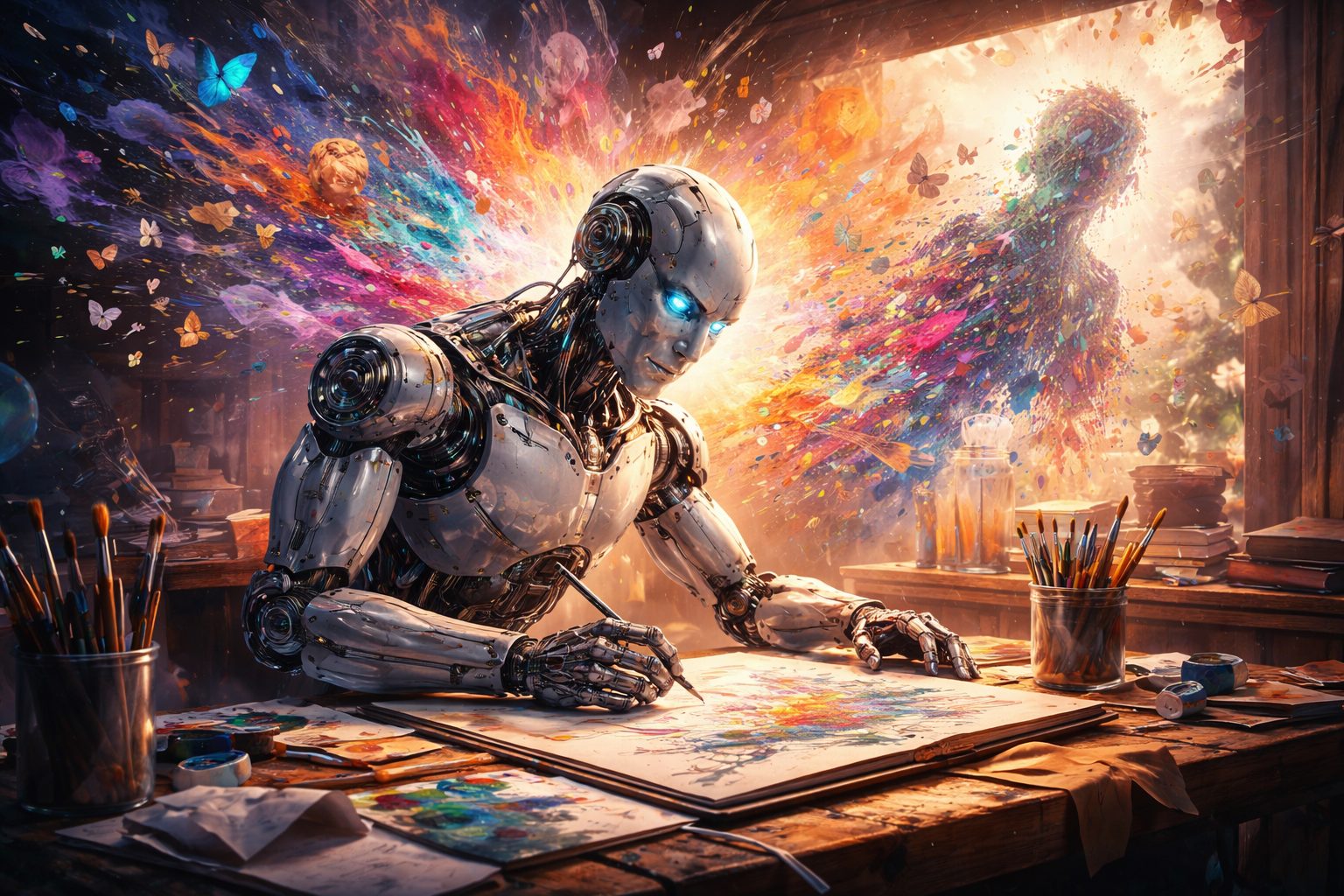
Artificial intelligence can now produce creative work that is, at the very least, as compelling as much of what human beings produce. Let me give an example.
Suppose someone submitted the following concrete poem, titled “boots on the ground,” to Open Arts Forum:
boots on the ground

mo boots on the ground ther
fa boots on the ground ther
ch boots on the ground ild

br boots on the ground ead
wa boots on the ground ter
do boots on the ground or

        boots on the ground
   boots on the ground
        boots on the ground

wi boots on the ground ndow
ta boots on the ground ble
bl boots on the ground anket

le boots on the ground ft
ri boots on the ground ght
le boots on the ground ft
ri boots on the ground ght

si boots on the ground ster
bro boots on the ground ther
gr boots on the ground andmother

         boots
         boots
         boots

       on the ground
       on the ground

ho boots on the ground use
ki boots on the ground tchen
sc boots on the ground hool

na boots on the ground me
fa boots on the ground ce
st boots on the ground reet

        boots on the ground
  boots on the ground
       boots on the ground

bo boots on the ground dy
bl boots on the ground ood
bo boots on the ground ne

cr boots on the ground ying
bu boots on the ground rning
wa boots on the ground iting

no boots on the ground doctor
no boots on the ground water
no boots on the ground answer

pr boots on the ground ayer
sl boots on the ground eep
dr boots on the ground eam

         boots
      boots
   boots
boots

  on
    the
      ground

so boots on the ground n
da boots on the ground ughter
fa boots on the ground ther
mo boots on the ground ther

        erased
        broken
        missing

        boots on the ground
 boots on the ground
       boots on the ground

ho boots on the ground me
li boots on the ground ght
he boots on the ground art

gr
ou
nd

gr
ou
nd

grief
Now, you may or may not like concrete poetry. (I do.) But if a human being had submitted this, I suspect that person would be published on the front page of Open Arts Forum quickly enough.
But what if we learned that the poem was produced by AI?
What changes, exactly?
Does the work become dismissible? Does it become less moving, less effective, less worthy of attention? And if so, why?
When we say that a work is worth reading, viewing, or contemplating, what exactly are we praising? The work itself? The human labor behind it? The intention? The struggle? The biography of the maker? Some combination of all of those?
This seems to me one of the central questions AI now forces us to confront, and perhaps not comfortably.
As both an editor and an author, I evaluate creative work all the time. I like to think I can judge a work on its own effectiveness, apart from who made it. But can I really? And should I?
I’m curious how others here think about this.
If an AI-generated work genuinely moves you, is that enough?
Or does authorship remain central to artistic value?
What, in the end, are we responding to when we respond to creative work?
Click the Comments link below to join the discussion.