Open Arts Forum
Opens in a new tab
Avatar image of James Spears
Open Arts Forum archive

James Spears

Born and raised in El Paso, now living in Albuquerque, writing to work light back into the veins.

OmahaPoetry

Omaha

James SpearsSeptember 6, 2024

Now this is a special kind of nowhere. Its midpoint even, a place equidistant from North and South, somewhere neither desert nor tundra. The…

AA #2 – Unnamed: We’ll Call Him MushroomPoetry

AA #2 – Unnamed: We’ll Call Him Mushroom

James SpearsJanuary 21, 2021

He doesn’t know where to start so he looks into the styrofoam cup to find a reflection he has become proud of staring from…

Giants
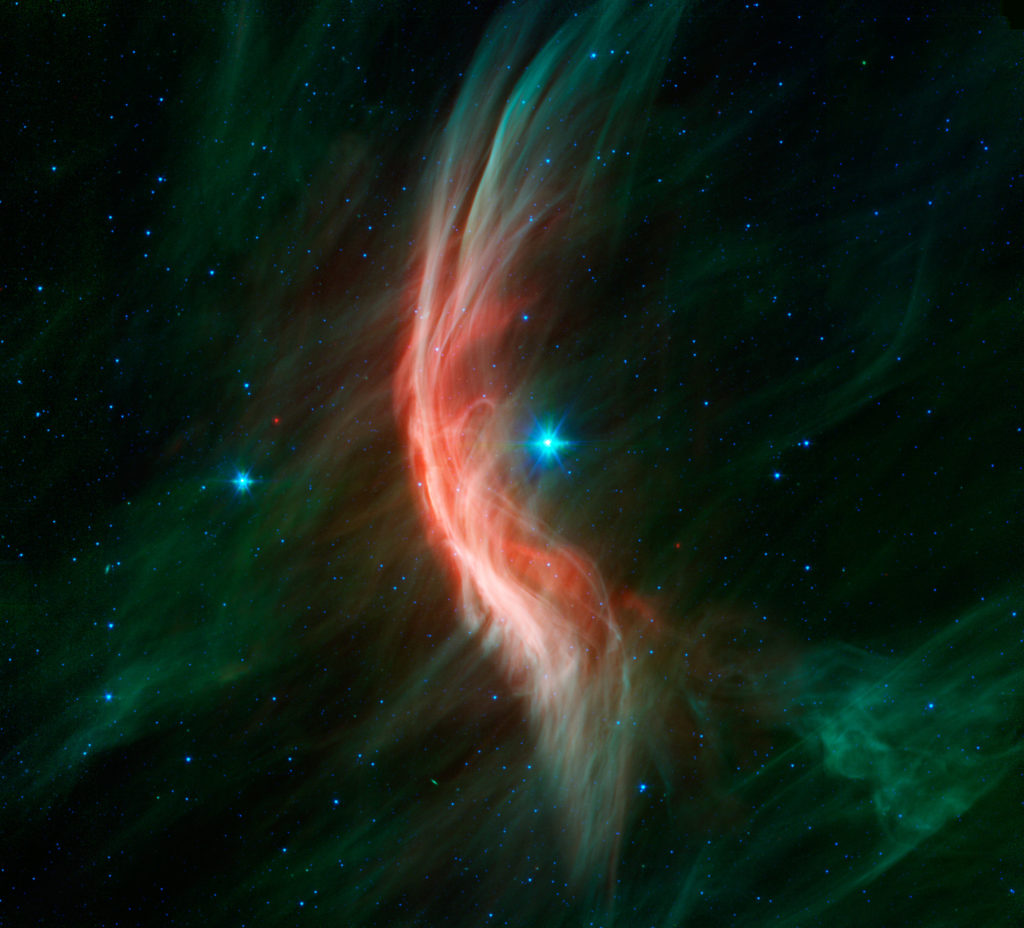
The giant star Zeta Ophiuchi is having a "shocking" effect on the surrounding dust clouds in this infrared image from NASA’s Spitzer Space Telescope. Stellar winds flowing out from this fast-moving star are making ripples in the dust as it approaches, creating a bow shock seen as glowing gossamer threads, which, for this star, are only seen in infrared light. Zeta Ophiuchi is a young, large and hot star located around 370 light-years away. It dwarfs our own sun in many ways -- it is about six times hotter, eight times wider, 20 times more massive, and about 80,000 times as bright. Even at its great distance, it would be one of the brightest stars in the sky were it not largely obscured by foreground dust clouds. This massive star is travelling at a snappy pace of about 54,000 mph (24 kilometers per second), fast enough to break the sound barrier in the surrounding interstellar material. Because of this motion, it creates a spectacular bow shock ahead of its direction of travel (to the left). The structure is analogous to the ripples that precede the bow of a ship as it moves through the water, or the sonic boom of an airplane hitting supersonic speeds. The fine filaments of dust surrounding the star glow primarily at shorter infrared wavelengths, rendered here in green. The area of the shock pops out dramatically at longer infrared wavelengths, creating the red highlights. A bright bow shock like this would normally be seen in visible light as well, but because it is hidden behind a curtain of dust, only the longer infrared wavelengths of light seen by Spitzer can reach us. Bow shocks are commonly seen when two different regions of gas and dust slam into one another. Zeta Ophiuchi, like other massive stars, generates a strong wind of hot gas particles flowing out from its surface. This expanding wind collides with the tenuous clouds of interstellar gas and dust about half a light-year away from the star, which is almost 800 times the distance from the sun to
Poetry

Giants

James SpearsJune 18, 2018

We are stars trying to collide, objects caught in our orbits dashed to rocks in process mean nothing; we merge. Made massive, other light…

Less TomorrowPoetry

Less Tomorrow

James SpearsJune 3, 2018

Fell asleep inside him after wind slipped through a window, found a crack into my absent mind. Tomorrow lurks around our edges, minutes fall…

Last Year’s CensusPoetry

Last Year’s Census

James SpearsMay 29, 2018

Eventually, we stop counting; the final bird of prey rips out the throat of the penultimate field mouse and dies soon after. Beyond its…